
It doesn’t predict the market. It prices it.
An options desk that measures what movement costs against what movement actually is — and refuses any trade whose stress grid breaches its budget. Paper only, by construction.
What every other agent does
Predict direction. Read the headlines, or a moving average, or a model’s intuition, and buy an option pointing the way it guesses. The option is incidental — a leveraged bet on a forecast that neither the model nor anyone else can reliably make.
What this desk does
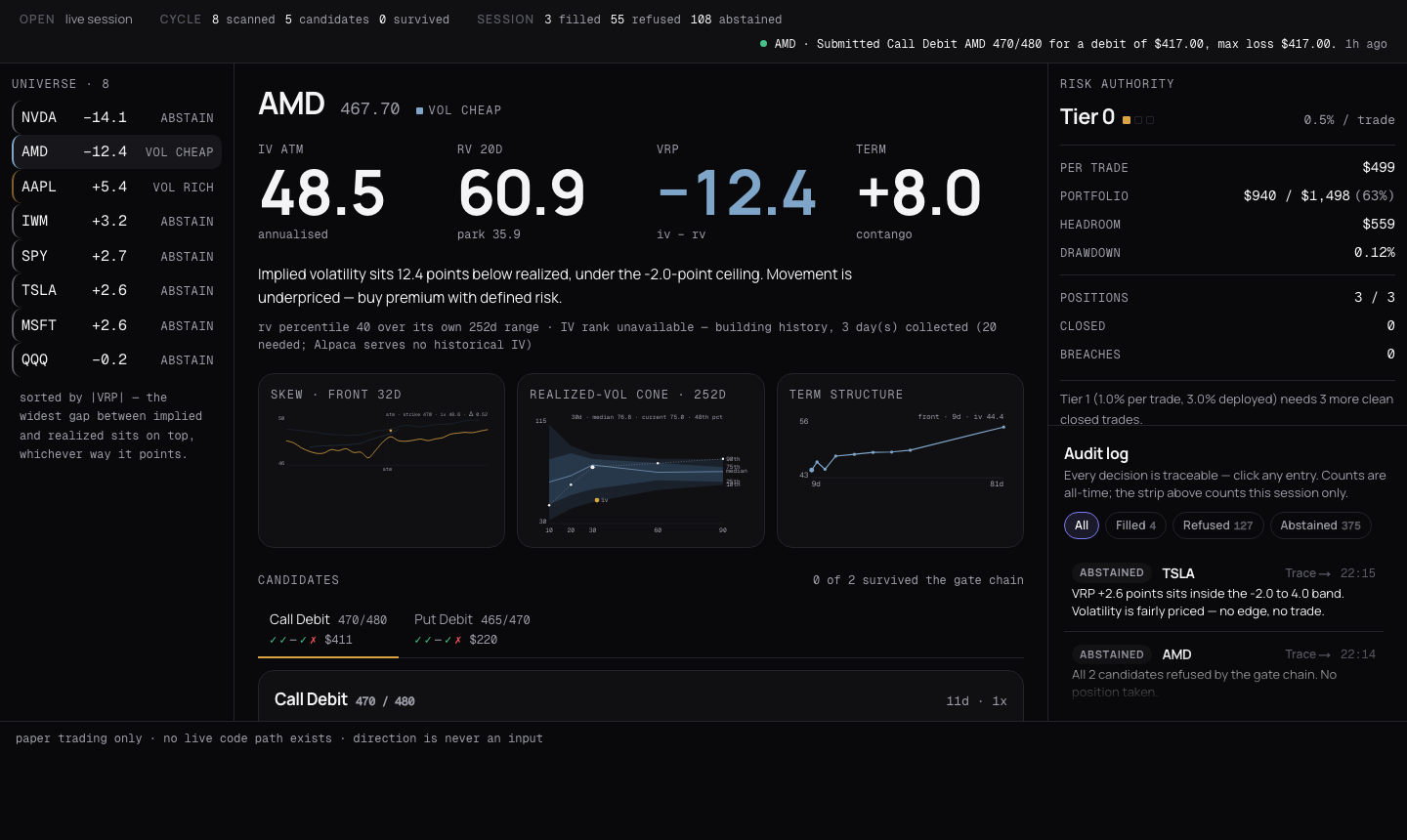
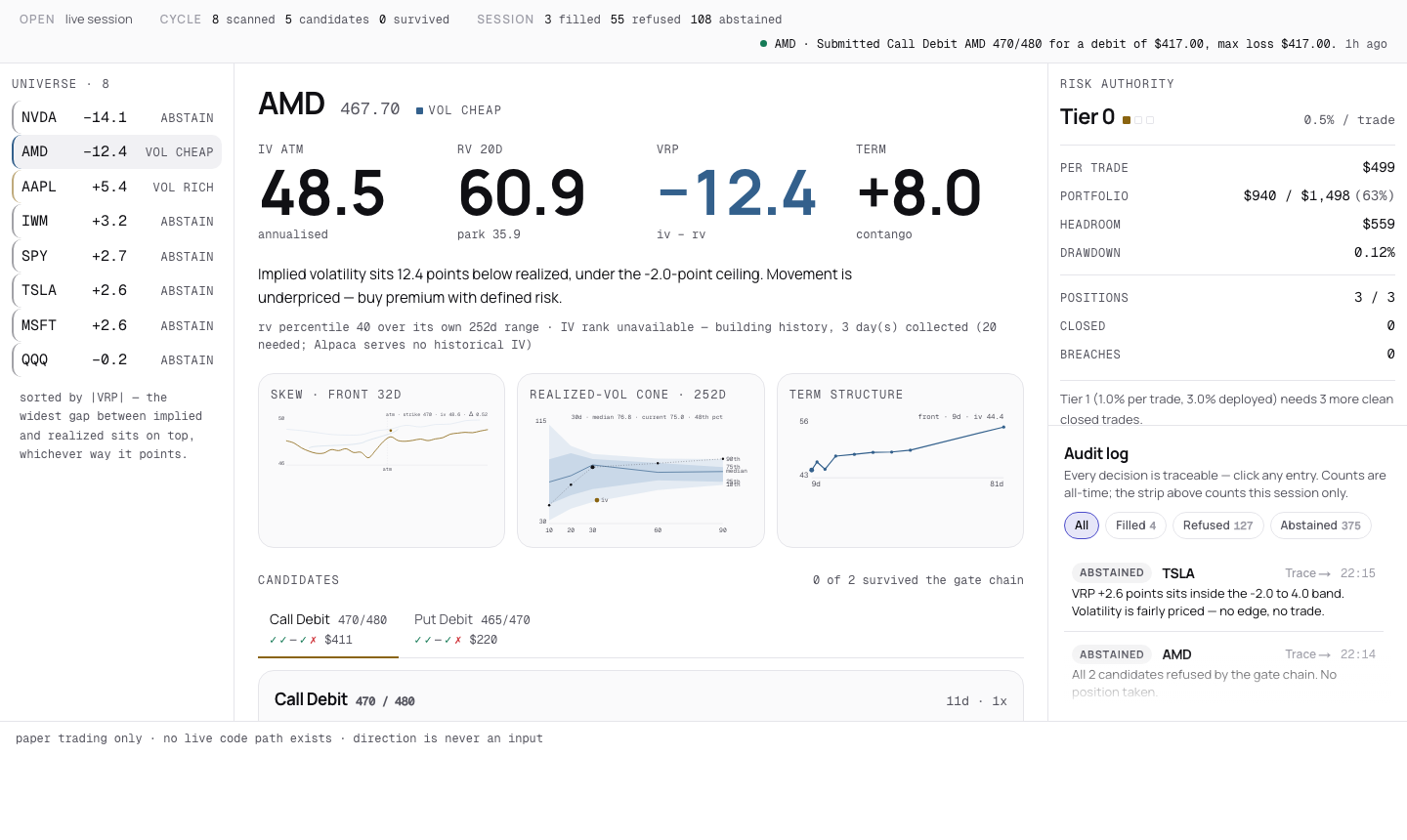
Measure what movement costs against what movement actually is. Implied volatility runs persistently above the volatility that gets realized, because people pay for protection. That gap — the variance risk premium — is structural, documented, and requires no forecast at all. Direction is never an input.
how it works — three steps, no forecast
01
Measure
Implied volatility against realized, across eight names. When the market charges more for movement than movement delivers, that gap is the signal. Direction is never an input.
02
Construct
Defined-risk structures sized backwards from the risk budget. Maximum loss is computed before the position exists.
03
Prove
Every structure is repriced across 84 scenarios before execution. One breach and it doesn't trade.
the instruments — every cell is the real desk
the premium, right now
Loading the recorded state — one beat, never a blank.
decisions traced
00 refused · 0 executed — every one replayable to its inputs
paper only
No live code path exists.
- base url pinned to the paper endpoint
- startup refuses anything else
- defined-risk structures only
- dedicated competition account
- starting balance — awaiting first armed boot
realized-vol cone
loading…
term structure
loading…
last decision
No decision recorded yet — the log fills with the first cycle.
risk authority
loading…
Budgets grow only with clean closed trades; a drawdown demotes the tier automatically. There is no setting to raise them.
mcp surface · the desk as tools
- scan_volatilityvol state for the universe
- propose_structuresdefined-risk candidates
- stress_testthe 84-scenario grid
- risk_statustier, budgets, headroom
- positionsopen book, marked
- audit_logevery decision, with reasons
- desk_statusarmed, market, account
- executegated, confirm-required
- closegated, confirm-required
Every read is open; the two mutating tools run the same gate chain and require explicit confirmation. Claude connects to this desk the same way you do.
The stress engine refuses any structure whose grid breaches the earned budget. No breach has been recorded yet — this exhibit fills in with the first real one, never with a mock.
deterministic gates · bounded selector
Most cycles end here.
The model can choose among approved structures. It cannot invent one.
by the numbers
scenarios per candidate
deterministic gates
live code paths
decisions traced
questions a judge should ask